VERIZON | VREPAIR NEXTGEN
TLDR | Enterprise-wide ticketing platform
Role | Senior Visual Designer/ Senior Product Designer
Responsibilities | Led extensive research, wireframed MVP and integrated with Verizon’s internal UX team.
Team | Six-person design team plus offshore engineering team

OverviewTHE CHALLENGE
Verizon needed to unify vRepair (a 20‑year‑old proprietary Wireline ticketing system) and WB360 (a licensed Wireless platform) into a single environment serving thousands of agents across very different workflows.
vRepair handled physical infrastructure repairs (Fios, copper, fiber, landline) while WB360 managed cellular and device issues. The goal was to migrate WB360's key capabilities into vRepair NextGen so agents could handle any ticket type without constantly moving between 21+ external databases, an inefficient workflow that caused delays, errors, and inconsistent decisions.
This meant designing a flexible, cohesive enterprise design system; dynamic admin dashboards to control screen and workflow configurations per team; and templates built for high‑variance, high‑volume operations.
The core challenge was turning two entrenched, divergent ecosystems into one scalable platform built for consistent workflows, cross‑domain decision‑making and future AI‑driven automation.
MY IMPACT
As Senior Product Designer and Senior Visual Designer, I led UX research and design building personas, empathy maps, and workflows, then synthesizing findings into wireframes and prototypes.
Embedded with Verizon’s internal UX team, I partnered with leadership and SMEs to map the structure and goals of both ticketing systems, then built a research‑backed roadmap that included workflow mapping for engineers and supervisors, customer‑journey conceptualization, and detailed sitemaps for both platforms, setting the foundation for design.
I just wanted to send a word of thanks to you folks for all the hard work you have done on the new UX design for vRepair. I have provided UI's to the NMC's in the past, but you folks truly did a outstanding job of understanding the problem, understanding what the current system does, interviewing the user community, understanding their workflow and providing a solution that will hopefully fit their needs.
You have been really fun and easy to work with and were always there to provide the guidance the team needed to move forward. I know that our relationship on this project isn't over as you move into a lower level of support and maintenance so it's not goodbye but I wanted you all to know how much I appreciate the hard work you guys provided. Thanks a ton.”
Jon Spieker | Senior Manager, Verizon Business Group, Global Network & TechnologyDiscover & DefineONE UNIFIED TEAM
Research Inputs:10 Group Interviews
40 Individual Interviews
1 Design Workshop
Research Outputs:9 Personas
~20 Empathy Maps
150 Workflows
286 Unique synthesized research findings, categorized & prioritized
HOW WE COLLABORATED
WONGDOODY and Verizon’s internal UX team, LuxCE, operated as one unified team throughout the project, integrating their foundational research and strategic plan from the start, collaborating on research strategy and design planning and jointly expanding the design system to meet vRepair NextGen's UI needs.
Together we developed Jira stories, shared new builds with development and maintained a continuous feedback loop across every design sprint, with LuxCE stepping in to help solve challenges as they emerged. By categorizing each research finding, we were able to prioritize features and screens to integrate and redesign.
WHO WE INTERVIEWED
Our research included Verizon employees and end users of both systems. We focused on understanding how engineers and supervisors used each system daily, when they needed to swivel to outside systems to work tickets and how each system could be improved.
RESEARCH ARTIFACTS


Pain Point 1:Time-intensive form completion
Pain Point 2:Heavy swiveling
Paint Point 3:Data-heavy displays
Pain Point 4:Weak search tools
Pain Point 5:Manual data validation
Pain Point 6:Inefficient ticket navigation
DevelopWORKING IN AGILE SPRINGS
CREATING PRODUCT SPECIFICATIONS
Our research findings drove our design approach. From there, we established the design and product specifications for vRepair NextGen's MVP, validating each decision with both business stakeholders and users to ensure clearly-defined outcomes were met.
Design and implementation sprints ran in parallel and WONGDOODY and Verizon's internal UX team and development team worked in lockstep to maintain momentum and alignment across every cycle.
STRATEGIZING USER ADOPTION
As the product began taking shape, we turned our focus to launch, developing a holistic User Adoption Strategy alongside a comprehensive Communication and Marketing plan to roll out vRepair NextGen across all seven centers.

Deliver GIVE USERS THE RIGHT INFORMATION AT THE RIGHT TIME

NEW LANDING PAGE DASHBOARD
Help users identify priority tickets to work and outstanding issues to address as they start their day.
SOLUTION RECOMMENDATION ENGINE
Using AI, help users identify recommended action(s) for solving tickets and provide quick access to the steps involved in taking that action.
OVERVIEWS & SUMMARIES + SHOW/HIDE PATTERNING
Show users key information about their tickets at the right time and allow users to customize their ticketing platform experience.
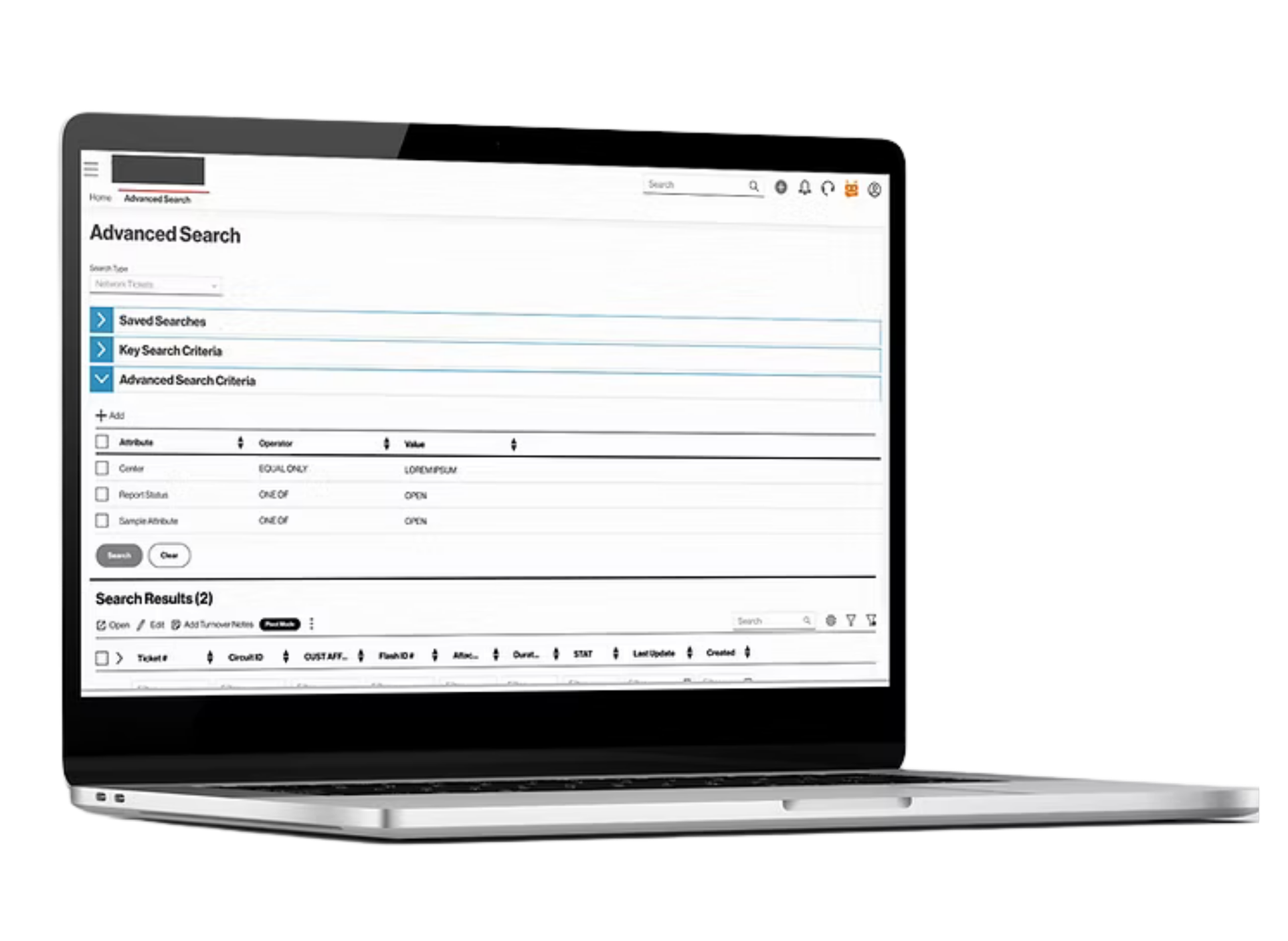
GOOGLE-LIKE SEARCH
Give users the ability to search open and resolved tickets, inventory and much more from one place using extensive filtering.
USE OF APIS & CONTEXTUAL IFRAMES
Reduce users’ need to swivel to external systems to find relevant information and validate data from vRepair.
QUICK ACCESS TO TICKET NAVIGATION
Allow users to take all actions on ticket from one place.