AIRBNB | AIRCARE REIMAGINE
TLDR | Human-in-the-loop claims resolution platform
Role | Product Design Consultant
Responsibilities | Principal Design IC (End-to-End)
Team | X-functional team of eight; Design team of two
OverviewTHE CHALLENGE
AirCover is Airbnb's built-in protection that supports hosts and guests with property damage, liability and trip disruptions. Internally, customer success representatives relied on AirCare, a claims management platform built on Salesforce, to review and process these cases.
As Airbnb began moving away from the limitations of SaaS based tools and investing in custom internal platforms powered by AI capabilities, the team faced a critical operational challenge; claims customer success representatives were navigating a disjointed, fragmented highly manual workflow that required extensive training and was inefficient.
With consistent, high provider turnover, Airbnb needed to redesign the workflow and experience so newer and less experienced providers could accurately and easily process the highest volume of claims while reducing complexity and utilizing AI-assisted decision making.
MY IMPACT
The goal of this project was to reimagine the end to end claims adjudication experience and define the design foundation for Airbnb’s future AI-powered claims platform.
I was the sole UX designer responsible for driving the project from concept to MVP with the objective of securing leadership buy-in with an offshore design team.
Operating in a highly ambiguous environment, I stepped into responsibilities well beyond design execution. The final prototypes served not only as development-ready specs and functionals communication solutions that aligned stakeholders around a shared long term vision for how AI transforms claim operations at scale.
“Charlotte was super on top of the work she was involved with. She asks pointed question in order to get clarity and I (we) really appreciate all she did!”
Cesar Motta | Manager, Product Ops & Process Optimization“I am sorry to see Charlotte go. Her contributions to Airbnb and the project are appreciated. I love the way she ask questions and holds the stakeholders accountable.”
Srinath Therampattil | Staff EngineerDiscoveryDISCOVERY WITHOUT A ROADMAP
Challenge 1:No Product Requirements Document.
Challenge 2:No access to claims representatives for interviews, the people doing the work day in and day out.
Challenge 3:No live site access as a contractor. I reconstructed context from 20+ training videos and a handful of screen shares.
Challenge 4:No research repository to build on, just 2 generic claims representative personas, created in 2022.
Challenge 5:No usability testing during MVP ideation.
Challenge 6:The only data available was a 2024 user experience survey and NPS highlights, both predicating major product updates, making them unreliable signals for current pain points.
XFN INTERVIEWS
I spearheaded cross functional interviews (across product, ops, engineering and service design/innovation) that served two goals: understanding how the product team operated and gathering secondhand qualitative insights about representatives from feedback team members received over the years.
I needed to map team roles and responsibilities, team-specific goals for Aircare 2.0 and the status of in-progress automations, as well as understand which documents each team used to track their work.
I also used these conversations to build a clearer picture of how representatives engaged with the claims ecosystem; which systems they relied on, what rules and notifications governed their workflows and which existing features they valued or found frustrating. Finally, I validated my understanding of the primary flows for working an open claim, which I’d pieced together from demos.
FTE UX COLLAB
I requested to be connected with a full time UX designer at Airbnb who worked on external facing tools to access Airbnb’s latest design system, workshop ideas and receive tips for navigating an atypical team structure.
I also reviewed Airbnb’s 'Unreasonable Hospitality' and ‘10 Star Service’ Design philosophies full time designers were onboarded with.
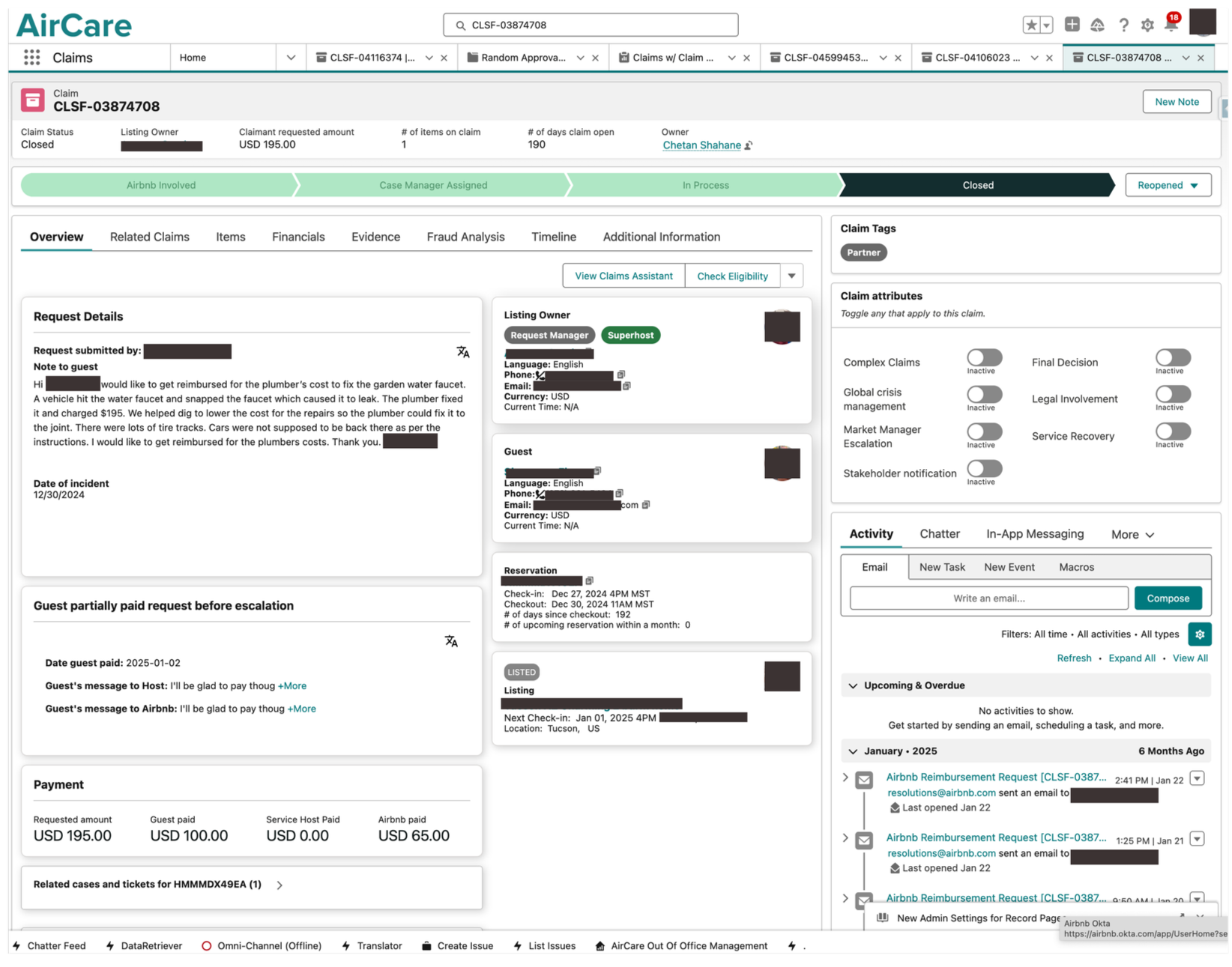
THE BEFORE

DefinitionMAPPING THE CLAIMS ECOSYSTEM & MANAGING THE PROJECT
CREATING CONTEXT
Through demos and conversations, I mapped the full landscape of claims tooling and created an extensive screenshot library, including the Reservation Center, Atrium, internal knowledge base and the specialist platforms representatives swiveled between during adjudication. This gave me critical context for where Aircare 2.0 needed to reduce friction and consolidate unnecessary system-switching along with inspiration for pattern’s from Airbnb’s finely tuned customer-facing products.
Years of incremental development had left Aircare with layers of complexity that the product team lacked full visibility into. I mapped features, claim prioritization logic and internal claim tagging that needed to be accounted for in the redesign.
DOCUMENTING WORKFLOWS
I documented workflows from intake through close in LucidChart, capturing each adjudication step, governing rules and automations, agent/guest/host notifications and internal handoffs, giving the team a shared visual language for reimagining workflows and surfacing gaps that could derail design.


FACILITATING STAKEHOLDER MEETINGS & PRD DEVELOPMENT
I facilitated weekly meetings across time zones, making structured agendas, clear action items and documented essential decisions. I prepared meeting materials, tracked open questions and ensured each session moved the work forward rather than revisiting the same unresolved conversations to the best of my ability. Managing alignment across this many functions, without a seasoned PM, was one of the most demanding and rewarding aspects of the engagement.
There was no PRD when I joined and each team was using separate artifacts to track short-term, mid-term and long-term goals. This led to misalignment and duplicated effort. I took ownership of synthesizing inputs from each team and facilitating conversations to resolve conflicting priorities.
DEVELOPING A SYSTEM FOR ONBOARDING DESIGNERS
Anticipating the cost of onboarding without documentation, I built a handoff guide covering prior research and team ways of working including a Figma research library and a plain-language breakdown of the full claims adjudication workflow we were planning to design the MVP for.
Develop REIMAGINING THE FUTURE OF AIRCARE

AI SIGNALS GUIDE REPRESENTATIVES
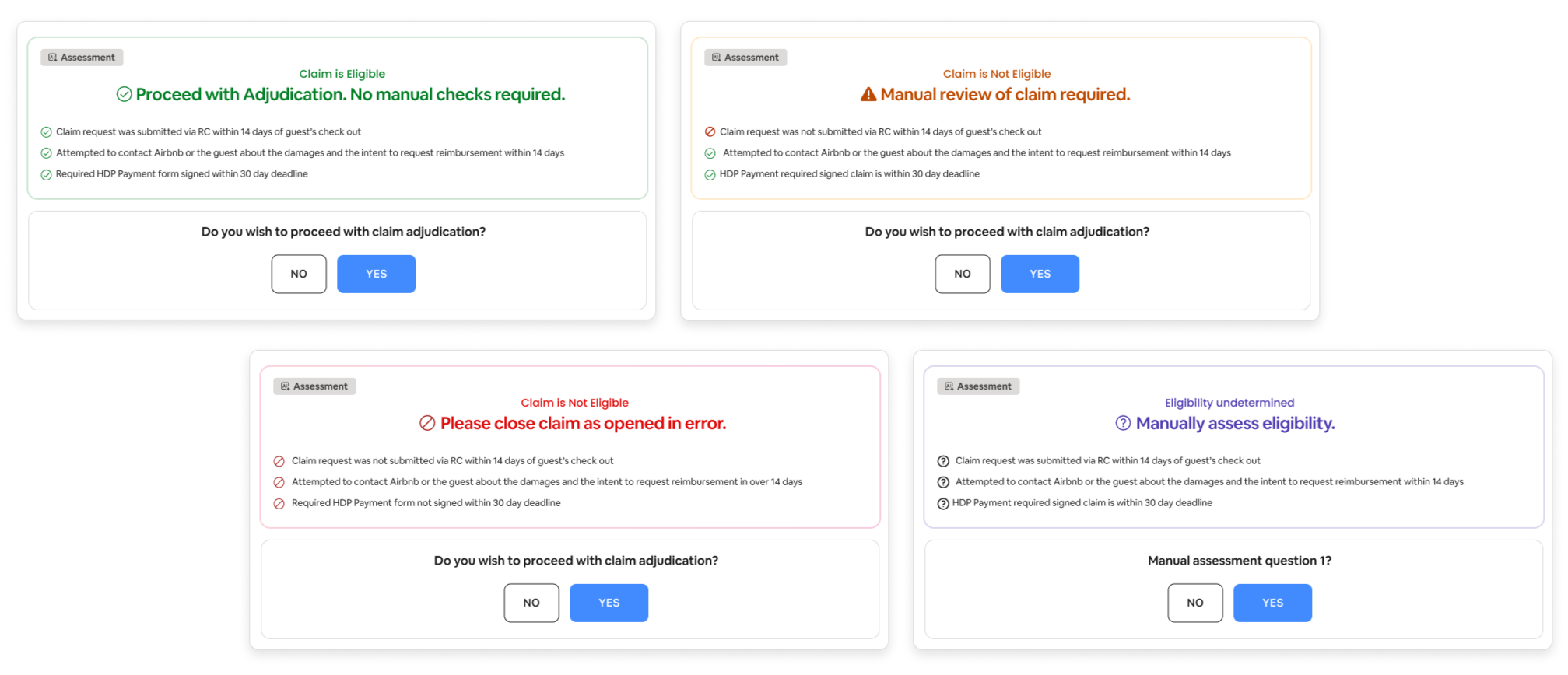
AI signals were embedded throughout the workflow to flag anomalies and surface recommendations. Rather than asking representatives to interpret raw data, the system provided directional guidance at each step by flagging suspicious patterns, suggesting next actions, estimating payout values and drafting communications.
The interface was designed with ambiguity around human vs. AI decision authority, giving the team flexibility to adjust automation levels as the technology matured.

MINIMALIST DASHBOARD WITH ON DEMAND DETAIL
Designed around the core principle that representatives should only see what they need for the task in front of them. Rather than surfacing all claim data upfront, the interface gave representatives a clean starting point with the ability to drill into detail. This was designed to reduce cognitive load for partner representatives handling high volumes of simple claims.
FUTURE READY DESIGN SYSTEM & PATTERNS
Built on the principle that the system needed to flex as AI capabilities matured. Components were inspired by Airbnb's external design system, Salesforce's SLDS2 and Lemonade and TurboTax UI (two stakeholder-cited benchmarks with patterns that seamlessly enabled task prioritization, simple adjudication and positive feedback loops).
DeliverSINGLE PANE OF GLASS MVP


Very limited form based interactions
One of the most significant shifts from the current state was the elimination of form-heavy layouts. Interactions were layered in contextually and representatives were prompted with only the inputs required for the current step. This kept the interface conversational rather than transactional.
DYNAMIC TASK LISTS
Dynamic task lists updated in real time as representatives moved through the adjudication workflow, reducing the reliance on external knowledge bases or supervisor escalation for routine decision-making.
NEXT BEST ACTION LOGIC
NBA (Next Best Action) logic was embedded using predictive models that surfaced the current step and recommended next action prominently.
REVIEW/APPROVE/DECLINE FLOWS
Representatives served as reviewers rather than processors, with the interface surfacing only what required human judgment. Central to the MVP were structured flows for reviewing, approving and declining claims. These flows were designed to guide partner representatives through the adjudication steps (eligibility check, guest responsibility determination, evidence validation, etc.) with automation handling the lowest-risk, most straightforward decisions.
EXPLORATORY AUTOMATION
Simple claims (those meeting pre-defined criteria for low risk and high confidence) were designed to be auto-processed without representative intervention. For more complex claims, AI triage surfaced the right context and flagged the right specialist early in the workflow, preventing downstream escalation and the kind of claim reassignment that had historically cost the team time and accuracy.